Paving Around Mature Trees
Roots, Heaving, and Smart Driveway Design
Across Central Ontario, one of the most common driveway problems starts with a tree the homeowner values.
A large sugar maple at the top of the drive. A pair of oaks older than the house. They shade the yard through the summer and add real character to the property, so removing them is the last thing most owners want to do.
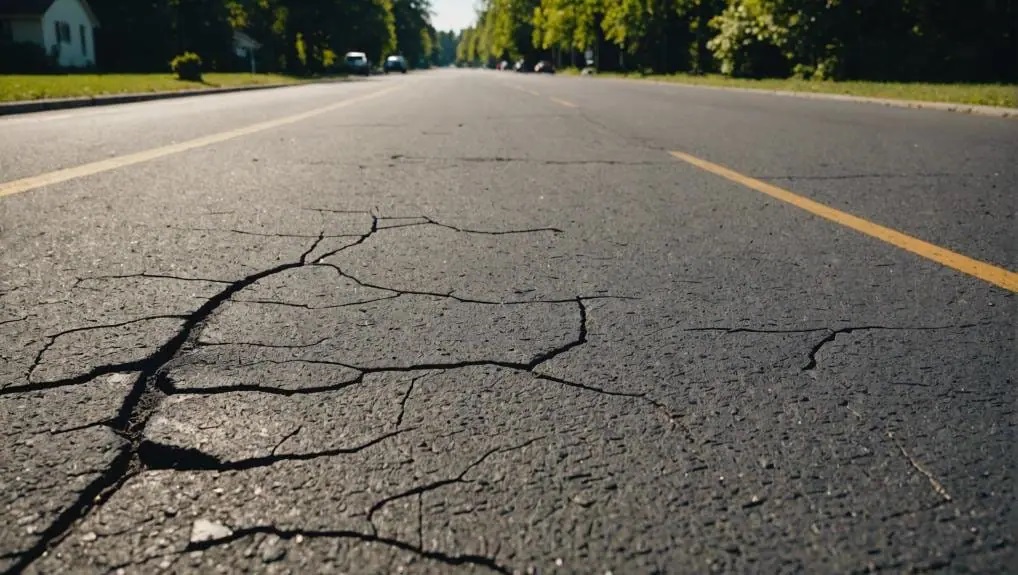
Then a ridge appears across the asphalt one spring. The next year a crack runs along the line of a root, and the section near the trunk sits an inch higher than the rest. At that point it can feel like a choice between the tree and the driveway. It usually isn’t.
A driveway and a mature tree can share the same ground for decades when the paving accounts for the roots from the beginning. The problem is that most driveways weren’t built that way.
This post explains what causes the damage, which fixes actually help, and when moving the driveway is the better decision.
Why Tree Roots Lift Asphalt
Roots don’t grow toward a driveway to attack it. They grow toward water, oxygen, and nutrients, and they spread wherever those are easiest to reach. That’s usually the top foot of soil. A paved surface often traps moisture and allows some air exchange around its edges, so roots tend to follow the ground right beneath it.
The lifting happens slowly. A root begins thin and thickens in diameter each year as the tree grows. That steady increase in width is what causes the damage. It isn’t a sudden force, but a few millimetres per season of a root pressing against a surface that can’t give way.
Over five to ten years, that pressure is enough to raise a section of asphalt or open a crack along the root’s path.
Asphalt has one trait that makes the problem more visible. It’s a flexible surface, which is part of why it handles freeze-thaw winters better than rigid concrete in many cases. That same flexibility means it shows movement from below. A root that would barely affect a thick concrete slab can create a clear hump in asphalt.
Once a small crack forms, water enters, the root follows the easier path, and the damage progresses faster.
Frost Heave and Root Heave in Central Ontario
Tree roots are a factor everywhere. In this region, they’re only part of the problem.
Local winters put driveways through repeated freeze-thaw cycling. Water enters the base, freezes, expands, and lifts the surface, then thaws and settles again, repeatedly from November through April. This is frost heave, and on its own it’s the leading reason driveways here fail early.
A treed lot adds a second force. Roots lift from below while frost raises and lowers the surface through the season, and the two problems compound each other. Heave opens a crack, the crack admits water, the water freezes, the crack widens, and a root finds the opening.
Many older cottage and rural lots through Muskoka, Oro-Medonte, and Springwater sit on heavy clay or a thin layer of soil over rock. Clay holds water and drains slowly, and compacted clay keeps roots shallow because they can’t grow downward into it. Instead, they spread outward, often directly under the driveway.
On that kind of lot, a nearby tree won’t root deep and leave the surface alone. It will grow shallow and wide.
Where a Tree’s Roots Actually Grow
This is the detail that changes how the whole problem should be approached.
Many people imagine a tree’s roots as a mirror of its branches, with a deep central root running straight down.
For most mature hardwoods, that isn’t accurate. The majority of the root system is shallow and wide. Roughly 85 percent of a tree’s root mass sits within the critical root zone, and most of those roots grow in the top 18 inches of soil. The fine feeder roots, which absorb most of the water, often extend well past the edge of the canopy.
Arborists use a simple guide to estimate this area.
The critical root zone extends about one foot of radius for every inch of trunk diameter measured at chest height. A mature maple with a 20-inch trunk has a critical root zone reaching roughly 20 feet in all directions. The dripline, or outer edge of the branches, serves as a reasonable estimate when measuring the trunk isn’t practical.
This matters for a driveway because the roots visibly lifting the asphalt are rarely the full extent of the system, and the roots involved reach much further from the trunk than most owners expect. It also affects the most obvious repair.
Why Cutting Large Roots Is Risky
When a root lifts a driveway, the first instinct is to cut it out. In some cases that’s acceptable. In many it isn’t, and the difference is worth understanding before any cutting begins.
Fine feeder roots can usually be pruned with little effect. Large roots cannot. Any root more than about four inches across is likely a structural root, one of the anchors that keep the tree upright. Removing several of these can harm the tree’s health and reduce its stability.
A mature maple that loses a major structural root on the driveway side may become a tree that falls in the next strong windstorm, onto the driveway, or the house. The damage also tends to stay hidden.
A tree that loses too much root during paving or excavation often looks healthy for the first season or two. The decline appears three to five years later as dieback in the canopy, long after anyone connects it to the driveway work. Healthy-looking trees are sometimes removed years later for damage that traced back to roots cut during a hardscaping project.
Several signs indicate that roots are already affecting a driveway:
- A ridge or hump in the asphalt running in a line, usually pointing back toward the tree
- Cracks that follow a curved path rather than the straight lines of typical frost cracking
- A section of driveway sitting noticeably higher near the trunk
- Surface roots already visible at the edge of the pavement or in the nearby lawn
- Water pooling in a low spot beside a raised section
When these appear, the tree and the driveway are already in conflict. The goal is to resolve it without harming either one.
Design Choices That Protect Both the Driveway and the Tree
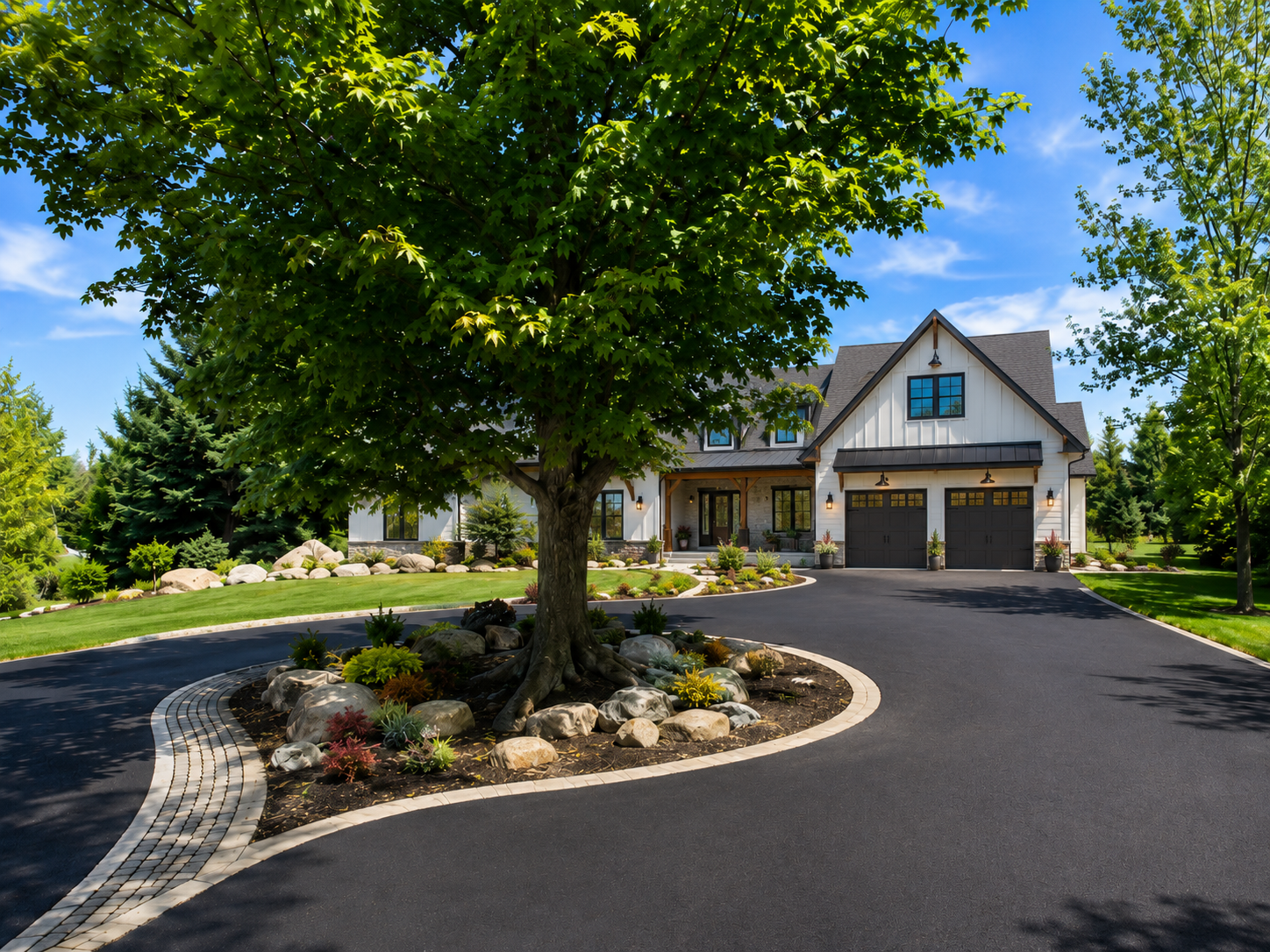
In most cases there’s no need to choose between the tree and a driveway that lasts. The driveway simply has to be built with the tree in mind, which is a different process than paving an open lot.
The choices that make the difference include:
- A proper granular base, built deeper near the tree. A quality crushed-stone base serves two purposes. It supports the load, and it gives roots a path of air and water so they don’t need to grow up into the pavement. An inadequate base is the most common reason driveways on treed lots fail quickly.
- Drainage that directs water away from the surface. Roots follow moisture. If the most reliable water during a dry stretch sits trapped under the asphalt, the roots will grow there. Proper grading and drainage move water away from the driveway and give the roots a reason to grow elsewhere.
- Root barriers on younger or smaller trees. A vertical barrier installed between the tree and the driveway directs roots downward so they pass beneath the pavement rather than into it. Timing is the limitation. Barriers work as a preventive measure, before roots establish under the surface. On a tree that’s already lifting the driveway, they rarely help.
- Flexible or modular surfaces at the closest point. Where a driveway runs near a trunk, changing the surface for that section can be the better option. Permeable pavers, or a section that can be lifted and reset, will handle root movement far better than a continuous asphalt slab, and they allow water and air to reach the roots.
- Shifting or narrowing the driveway. A driveway doesn’t need to be the same width along its full length. Pulling the edge back a few feet where it passes the tree, or adding a gentle curve, can move the pavement out of the densest part of the root zone. A small design change during planning costs far less than removing a heaved slab years later.
None of these methods are unusual. They’re decisions that must be made before paving begins, which is why the planning matters more than the materials.
When to Reroute or Rethink the Layout
Sometimes the correct answer is that the driveway is in the wrong location.
If a mature tree sits directly in the planned path of the driveway, and its root zone covers the entire area, no amount of careful base work resolves the underlying conflict. In those cases, rerouting the drive is the better investment, even if it means a curve that wasn’t originally planned or the loss of a parking spot or two.
A driveway moved once costs less than one repaved every decade.
It’s worth stating plainly that removing a healthy, mature maple or oak to preserve a straight run of asphalt is rarely the right decision. These trees took decades to reach their size, they add value to the property and reduce summer cooling costs, and a driveway can be designed around them.
The decision changes only when the tree itself is the problem. A silver maple that’s already heaving the slab, leaning toward the house, and showing signs of rot is a different situation, and removal may be the responsible choice for reasons unrelated to the pavement.
When the decision is genuinely close, consult a certified arborist first.
An arborist can identify which roots are structural, determine whether the tree will tolerate the work, and assess whether it’s healthy enough to design around. Coordinating that assessment in advance is far better than paving over a problem that returns in a few years.
Paving a Treed Lot the Right Way
When we quote a driveway on a treed property around Barrie, Bracebridge, Gravenhurst, or anywhere in cottage country, the trees are part of the assessment from the start. We consider where the roots are likely growing, how the lot drains, the condition of the soil, and whether the layout can shift to keep the pavement clear of the densest root zone.
We then build the base and drainage to match, rather than paving as we would on an open lot. The extra planning at the start prevents a cracked, heaved driveway and a stressed tree later on.
If you have a large maple or oak near your driveway and want a surface that lasts without losing the tree, this is the kind of project we handle regularly. Ital Paving has worked on treed and rural lots across Central Ontario and Muskoka for 40 years.
Contact us for a free estimate and an honest on-site review of your options. There’s no deposit required, and every job is backed by a written guarantee.
Related Articles
Residential & Commercial Estimate Request
Ital Paving provides free, no-obligation onsite consultations for all residential and commercial paving projects.
Our experts will perform a technical assessment of your property in Barrie, Orillia, or Muskoka to ensure your new infrastructure meets the highest standards of safety and durability. Complete this short form today to get started.