
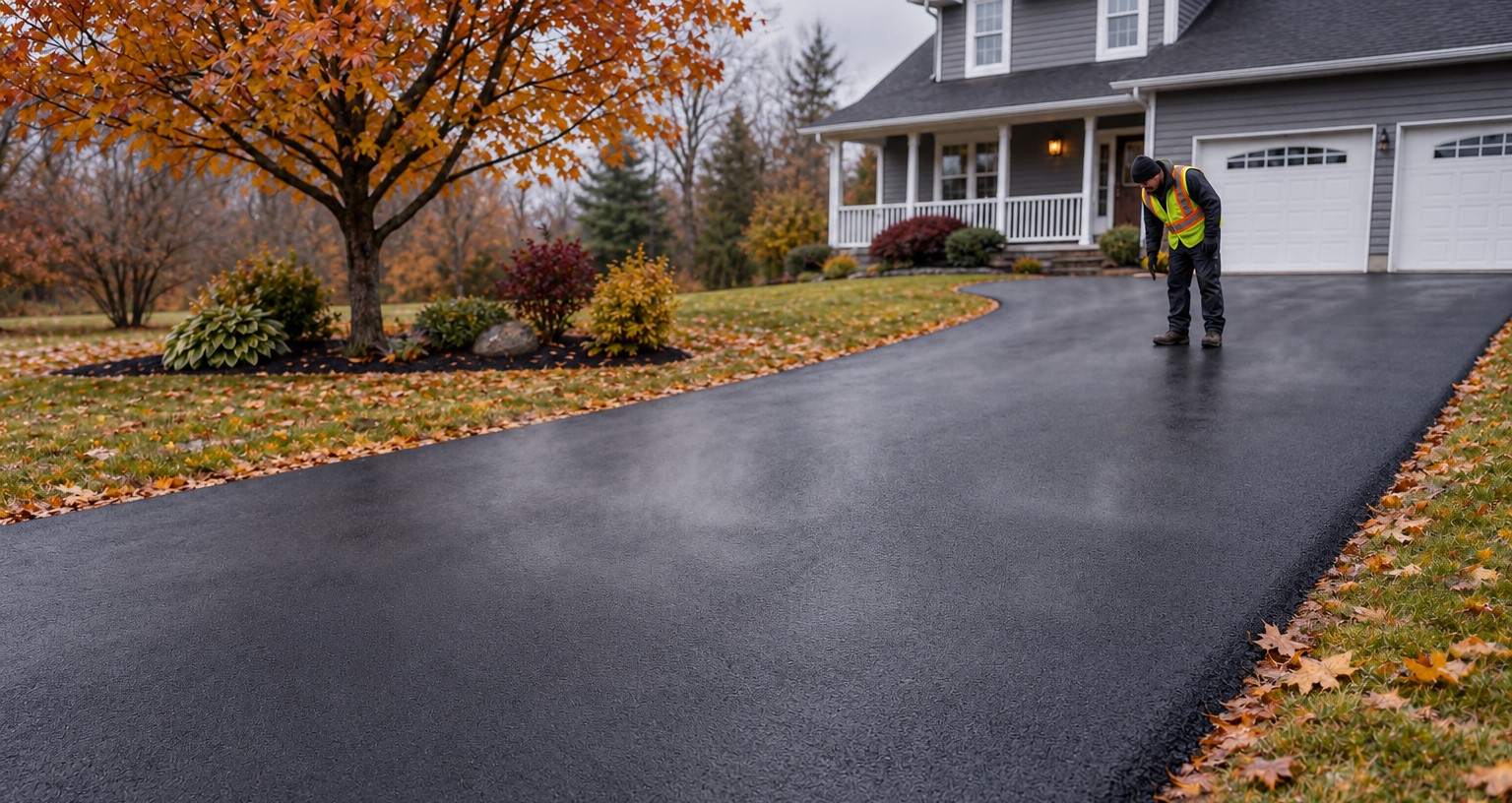
Asphalt Curing in Cool Fall Weather
Many homeowners in Central Ontario book driveway paving in the fall so the work is finished before the snow arrives.
Cooler weather changes how asphalt behaves on the day it’s laid and in the months that follow. The temperature of the air and the ground decides how well the crew can compact the asphalt, how quickly the surface hardens, and whether a job can go ahead on a given day.
Homeowners planning fall work usually ask whether cold weather weakens new asphalt, how long the surface takes to harden, and why a paving date can be postponed on a day without rain.
The sections below explain what curing means for asphalt and how cold ground and cool air limit the time a crew has to compact it. They also describe what a driveway paved in October goes through in its first winter and its first summer, and how temperature shapes the schedule for late-season work in Barrie and Muskoka.
What Curing Means
Asphalt doesn’t cure the way concrete does. Concrete hardens through a chemical reaction between cement and water.
Hot mix asphalt is a blend of crushed stone and asphalt binder. The binder is a heavy petroleum product that’s soft when hot and stiff when cool, so the mix arrives on site hot and hardens mainly by cooling down.
Some of the binder’s lighter components evaporate during mixing and paving, and the binder begins to react with oxygen at the same time. The oxidation continues for the life of the pavement and makes the binder gradually stiffer. Over many years, the stiffening also makes the surface more brittle and more likely to crack. The top of the driveway ages faster than the layers underneath because it’s exposed to air, sunlight and heat.
For asphalt, “curing” covers the cooling on the day of paving, which takes hours, and the slow stiffening of the binder over the following months. Cool fall weather shortens the cooling and slows the stiffening.
The Compaction Window
After the paver spreads the mix, steel rollers press the stone and binder together to squeeze out air and lock the stone in place. Rolling only works while the binder is hot enough to let the stone move. For the dense mixes used on driveways, compaction stops at about 79°C. A roller can still smooth the surface below that temperature, but it can’t make the asphalt any denser.
The time the mix takes to cool to 79°C is the crew’s working window. Several conditions set its length:
- The temperature of the surface underneath has the largest effect, because heat moves from the hot mix into a cold base faster than it moves into the air.
- Wind carries heat off the top of the asphalt and makes it cool faster.
- Sunshine slows cooling, so a cloudy fall day leaves less time than a sunny one at the same air temperature.
- Thicker layers hold heat much longer than thin ones.
Published cooling figures show a 50 mm layer of asphalt laid at 121°C staying workable for about 16 minutes on a base at 16°C and for about 12 minutes on a base at minus 4°C.
Cold Ground
Ontario’s provincial paving specification doesn’t allow a crew to place hot mix on a frozen base or a wet surface, since a frozen or wet granular base pulls heat out of the bottom of the new asphalt before the rollers can compact it. A frozen base also loses strength when it thaws in spring, and the asphalt on top can crack if the base settles unevenly.
In Barrie, the average October high is about 13°C and the average low is about 4°C.
The first fall frost usually arrives in mid-October. By November, the average daytime high has dropped to about 6°C, just below the 7°C minimum air temperature for placing the top layer of asphalt. Muskoka is a few degrees colder, and Huntsville averages a November high of about 4°C with overnight lows below freezing.
Density and Driveway Life
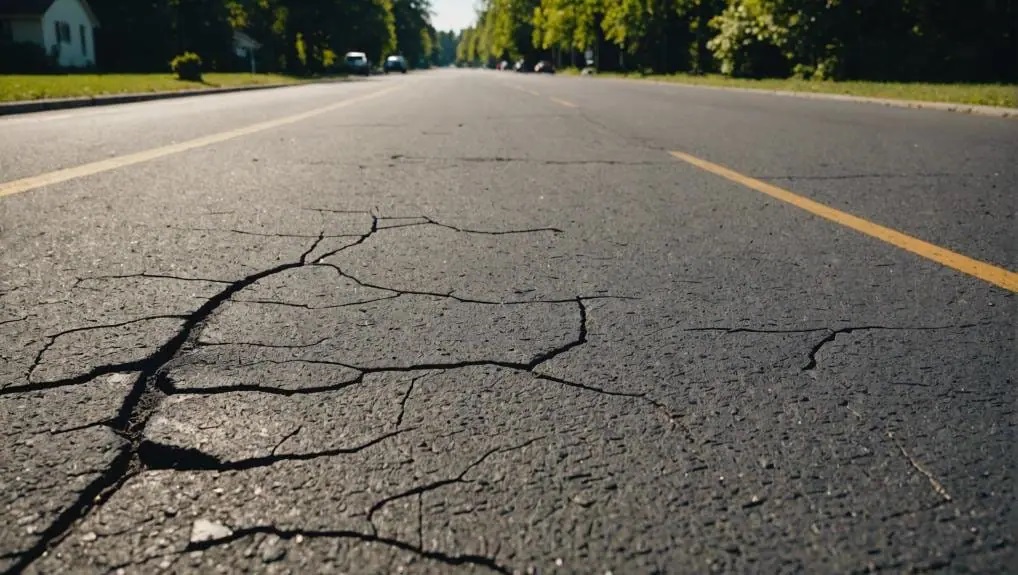
A driveway rolled after the mix has cooled too far can look smooth and black on the day the crew finishes, but it contains more air than it should. The air spaces connect with each other and let water into the asphalt. Water expands by about 9% when it freezes, and repeated freezing and thawing pushes the stone apart.
Over time, loose stone breaks away from the surface, and cracks open sooner than they would in a well-compacted driveway. A study by the New Jersey Department of Transportation found that every 1% reduction in the air content of compacted asphalt extends its service life by roughly 10%.
The crew paves a driveway that’s too wide for one pass of the paver in strips, and each new strip goes down against the edge of the strip beside it. The seam where two strips meet is called a joint.
The edge of the first strip cools while the crew lays the next one, and the cooled edge is harder to compact than the middle of a strip. Joints have lower density than the surrounding pavement, and water gets into the asphalt more easily there.
On a cold, windy day, the first edge cools faster still, and the joint ends up with even less density.
Right After Paving
The binder firms up quickly in cool weather once the crew finishes rolling, so a driveway paved on a 12°C afternoon is firmer in its first few days than one paved during a July heat wave. Tire scuffs and marks from parked vehicles are less of a problem in October than in summer.
The binder hasn’t had time to stiffen through oxidation, though, and it softens again whenever the weather warms up.
On a warm fall afternoon, turning the steering wheel while the car is stopped can twist the surface. Motorcycle kickstands and trailer jacks put their weight on a small point and can press holes into the asphalt. A vehicle parked on the same spot every day can leave dents.
A Driveway’s First Year
A driveway paved in the fall goes through its first Central Ontario winter only weeks after the crew lays it.
Well-compacted asphalt on a properly built base handles winter without trouble, but a plow blade or a metal shovel can still gouge the new surface. The surface stays intact when the plow operator sets the blade slightly above the asphalt and the homeowner clears the rest with a plastic shovel instead of a metal one.
A driveway paved in late October goes into its first summer without a season of warm weather behind it to start the stiffening.
When the first hot spell arrives in June or July, the surface is softer than it will be in later years and marks more easily. Turning the steering wheel while parked or leaving a trailer jack on the asphalt causes the same damage that summer as it would in the first few weeks.
Sealer needs warm, dry weather to set, and new asphalt needs time for the binder to stiffen before it can take a coat. For a driveway paved in the fall, the first sealcoat has to wait until the next warm season at the earliest.
Scheduling Fall Paving
A dry fall day can still be unsuitable for paving if the base is frozen or wet, or if the air is too cold or too windy. On late-season jobs, the crew often makes the final call on the morning of the work, after checking the surface and the forecast for the hours the job will take.
Homeowners can expect a few differences when they book late-season work:
- Start times tend to be later in the morning, because frost and dew have to clear from the base first.
- Crews may schedule jobs on heavily shaded lots for the warmest part of the day, since the base in shade stays cold longer.
- Paving days end earlier than in summer, because the air cools and the low sun stops warming the surface by late afternoon.
A warm stretch in early November can allow good paving conditions, while a cold, windy week in mid-October can stop work entirely. Suitable paving days end earlier in Muskoka than around Barrie and Orillia. Homeowners who book earlier in the fall have more room to move the date if the weather turns.
Ital Paving in Central Ontario
Cool fall weather doesn’t weaken new asphalt when the crew lays it in suitable conditions. The asphalt hardens by cooling on the day of paving, and the binder keeps stiffening over the following months.
Problems with late-season paving start with a frozen or wet base, or with a cold, windy day that leaves the crew too little time to compact the asphalt, and postponing the date avoids both. A driveway paved in the fall needs the usual new-asphalt care through its first winter and its first summer, and its first sealcoat waits until the following warm season.
Ital Paving has been paving driveways in Central Ontario since 1985, serving homeowners in Barrie, Orillia, Gravenhurst, Bracebridge, Huntsville and across Muskoka. To discuss a new driveway or a replacement before the season closes, contact Ital Paving to arrange an estimate.
Related Articles
Residential & Commercial Estimate Request
Ital Paving provides free, no-obligation onsite consultations for all residential and commercial paving projects.
Our experts will perform a technical assessment of your property in Barrie, Orillia, or Muskoka to ensure your new infrastructure meets the highest standards of safety and durability. Complete this short form today to get started.