
How Heavy Vehicles Damage Asphalt Driveways
Residential driveways in Central Ontario are built for cars. Many of them end up carrying much heavier loads, including a fifth wheel stored over the winter, a loaded dump trailer, or a delivery truck. The damage those loads do shows up as cracking, sinking, and broken edges.
How much of that damage is avoidable depends on the load itself and on the way the driveway was built in the first place.
What follows covers how much difference vehicle weight makes, why a bicycle marks asphalt that a parked car leaves alone, what a trailer does to a surface it stands on all winter, and what a homeowner can do once the driveway is already in the ground.
Weight And Damage
Road engineers work from a long-standing rule of thumb that doubling the weight on an axle multiplies the wear by about sixteen.
The rule was worked out for highways rather than driveways, so the figure is not exact on a residential lot, but the scale of it holds. A three-quarter-ton pickup is several times harder on asphalt than a mid-size sedan. A loaded delivery truck making one trip up the driveway and back can do more damage than a full year of car traffic.
The weight on each axle matters more than the weight of the vehicle overall.
A family sedan puts about 800 kg on each of its two axles. A tandem-axle utility trailer loaded with landscaping stone puts closer to 2,200 kg on each of its two, and under the same rule that works out to roughly sixty times the damage per trip.
A few loads of topsoil or crushed stone can mark a driveway that years of car traffic left untouched.
Where Load Travels
An asphalt driveway is a layered structure rather than a slab.
The asphalt is the surface you drive on, under it sits compacted gravel, and under that sits the natural soil. Weight spreads outward as it moves down, so a tire pressing hard on a small patch of asphalt puts a much gentler pressure on a much wider area of soil at the bottom. The gravel base carries the structural work and the asphalt on top mainly seals and surfaces it.
Thin asphalt over a shallow base passes the weight to the soil before it has spread far enough, and the soil sinks under it. The asphalt above flexes with every vehicle that passes, and enough of that flexing cracks it from underneath.
Much of Central Ontario sits on clay, which loses a great deal of its strength when wet. A driveway built over clay with a deep gravel base will hold a heavy trailer. The same driveway over a thin base will fail under it no matter how well the surface is maintained.
Contact Pressure
A car weighing 1,800 kg spreads its weight across four tire footprints, each roughly the size of a postcard. A bicycle weighing 15 kg puts nearly all of its weight through a kickstand tip smaller than a toonie. The bicycle dents warm asphalt and the car does not, because damage depends on how much weight presses on each small patch of surface rather than on how heavy the whole thing is.
Anything resting on a small hard foot behaves the same way. The usual offenders on a residential driveway are:
- Trailer tongue jacks and the round steel pads on RV stabilizer legs, which carry hundreds of kilograms on a foot a few centimetres across.
- Motorcycle side stands, which put the full weight of the bike onto a single point.
- Portable basketball bases, patio furniture legs, and the caster wheels on a rolling floor jack.
- Disposal bins dropped off for a renovation, which land on four steel corners.
A scrap of soft plywood under one of these crushes flat and passes the weight through anyway. What works is a rigid plate wide enough to spread the weight over more surface. Purpose-made jack pads cost a few dollars at any trailer supply shop, and a thick block of solid wood does the same job.
Trailers And RVs
Trailers carry a large share of their weight at the front, somewhere between a tenth and a quarter of the loaded total, depending on the type of hitch. That keeps them stable at highway speed, but when the trailer is unhitched, all of that weight goes onto the jack foot sitting on the asphalt.
A mid-size travel trailer puts something like 250 to 600 kg on a pad the size of a coffee mug. A large fifth wheel can put well over a tonne on that same point. A motorhome on its levelling jacks is heavier again, and those jacks lift the whole coach clear of its suspension, so the four small feet take all of that weight.
Asphalt keeps deforming slowly under weight that never moves, so how long something sits matters as much as what it weighs.
A boat trailer left in one spot over the winter presses down steadily through months of freezing and thawing, and shallow depressions form under both wheels. Cottage properties in Muskoka and Parry Sound see this more often than suburban Barrie lots, since a boat and a camper end up wintering on the same stretch of asphalt.
Heat And Timing
Asphalt softens as it warms, and modern mixes mark more easily in hot weather than older ones did, which is the trade-off for holding up better through winter. New pavement is at its softest through the first full season, and a fresh black surface in direct summer sun runs much hotter than the air around it.
A trailer jack that leaves no mark in spring will sink into the same driveway in August, and power-assisted steering can twist a stopped tire hard enough to drag the warm surface sideways.
The reduced load signs that go up on township roads across Central Ontario every March are there because the ground underneath is temporarily weak. Frost leaves the ground from the top down, so meltwater cannot drain while the soil below is still frozen, and the saturated ground loses much of its ability to hold weight. Municipalities keep heavy trucks off those roads until they firm up.
A driveway has the same problem and none of the protection, and it is usually built lighter than the road it connects to. A topsoil delivery or a moving truck booked for early April lands on the driveway at its weakest point of the year.
Driveway Edges
Asphalt in the middle of a driveway is held on all sides by more asphalt. Asphalt at the edge is held on one side only, so a wheel running along the perimeter pushes it out and down at the same time. The edge cracks and breaks away in pieces before anything else does, and water gets into the base.
A truck towing a trailer swings wide to line up with the driveway, and the trailer tracks tighter through the turn than the tow vehicle does, so a trailer wheel routinely drops off the edge. Delivery drivers backing in do the same. Backfilling the shoulders with soil or gravel to within about an inch of the pavement surface supports the edge and lets grass grow up to the line.
Cosmetic Or Structural
Tire scuffing and light marking on a new driveway are cosmetic. They show up most often in the first hot season, they fade under normal traffic, and they have no effect on how long the pavement lasts. Attempts to repair them tend to leave a patch that looks worse than the mark.
Depressions become a real problem once they are deep enough to hold water after rain. Standing water in a dip turns into an ice patch in winter and seeps into the base underneath.
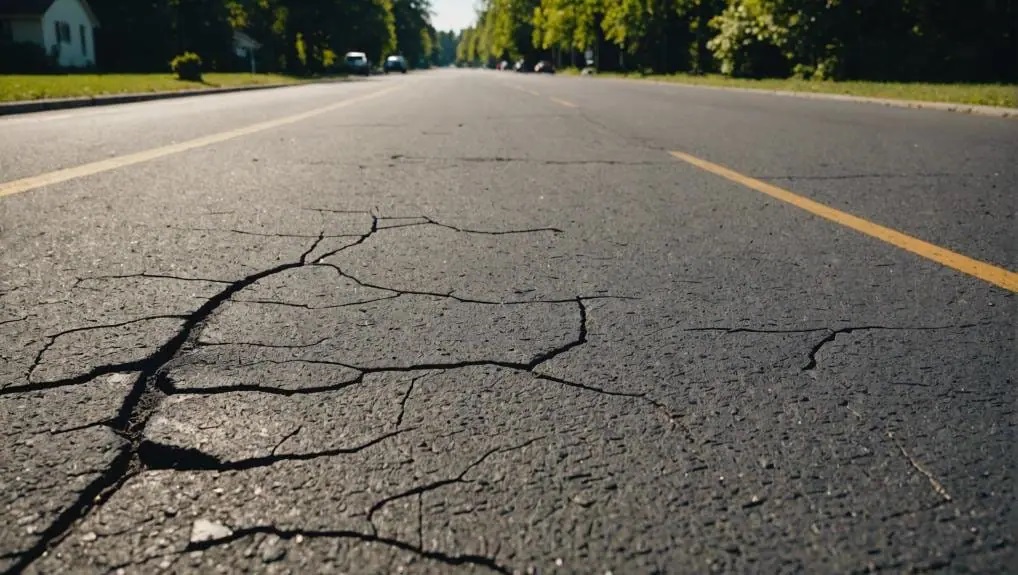
Interlocking web-shaped cracking across a wheel path or a parking spot means structural failure.
The layers below have been worn out by loads they were never built to carry, and surface treatments will not correct it. Depending on how far it has progressed, the fix is a full-depth repair of that section or a decision about whether to resurface or replace.
Reducing The Damage
Most of the damage above is avoidable with small changes in habits.
- Moving a stored trailer or RV a metre or two every few weeks keeps a depression from forming in one spot.
- Rigid pads under every jack foot, stabilizer leg, and kickstand prevent the dents that small hard feet leave.
- Marking the stopping point with a cone and repeating it in the delivery instructions keeps drivers centred on the driveway instead of feeling for the edges as they back in.
- Booking topsoil and crushed stone deliveries, moving trucks, and septic pump-outs for late spring or early fall avoids both the thaw and the summer heat.
- Letting the vehicle roll before turning the wheel prevents most surface scuffing.
Most of this is decided before the driveway is built. Two to three inches of asphalt suits a driveway that will only ever see two cars, while a driveway expected to hold a boat, a fifth wheel, or a work truck wants three inches or more over a deeper base.
Adding that depth later means rebuilding the driveway, so it is far cheaper to specify at the start.
Ital Paving has been building and repairing driveways across Barrie, Orillia, Muskoka, and Parry Sound since 1985, on suburban lots and waterfront properties. If a trailer, an RV, or a work truck will be parked at your property, that belongs in the conversation before the design is set.
Reach out for a free, no-obligation onsite consultation and the site can be assessed for the loads it actually has to carry.
Related Articles

Residential & Commercial Estimate Request
Ital Paving provides free, no-obligation onsite consultations for all residential and commercial paving projects.
Our experts will perform a technical assessment of your property in Barrie, Orillia, or Muskoka to ensure your new infrastructure meets the highest standards of safety and durability. Complete this short form today to get started.