
When Can You Pave A Driveway In Ontario?
Asphalt paving in Central Ontario runs from roughly May through October, and the window is narrower north of Severn Bridge. There are three conditions controlling it: frost in the ground, the supply of hot mix from an operating plant, and the temperature on the day the work is done.
Most homeowners treat the paving calendar as a scheduling problem driven by how busy the contractor is, but the date a driveway goes in affects how well the crew can compact the asphalt, and compaction determines how long it lasts.
In this article we cover what sets the limits of the paving season and how to plan a project around them.
Spring Load Restrictions Delay The Start
Paving season starts when reduced load restrictions come off rather than when the first warm week arrives.
Under Section 122 of the Highway Traffic Act, Ontario municipalities cap vehicles at five tonnes per axle on designated roads each spring. The County of Simcoe brought its restrictions in on March 9, 2026, and the Township of Muskoka Lakes ran from March 1 to May 25.
Huntsville and the other Muskoka municipalities generally run March through May, and each municipality sets its exact dates based on how quickly the thaw progresses. Those dates move, so check the current status with your own municipality, the District of Muskoka for District roads, or Ontario 511 for provincial highways.
Municipalities impose these restrictions because thawing frost and spring runoff saturate the ground under the road and temporarily weaken it. Heavy trucks on a weakened road base cause expensive damage well below the surface.
For a paving project, the effect is direct. Trucks hauling gravel to the site and trucks hauling asphalt from the plant either can’t legally use the route or have to run lighter loads across more trips, which raises the cost and gives the asphalt more time to cool on the way.
Your driveway sits on ground in the same condition. A gravel base compacted into saturated ground settles later, which is why Ontario’s construction standard prohibits paving over frozen ground and requires the surface to be dry and free of standing water before asphalt goes down.
Temperature Requirements For Asphalt
Ontario Provincial Standard Specification 310 (OPSS 310) governs asphalt placement on provincial and municipal road contracts. It carries no legal weight on a residential driveway, but it’s the standard the industry works to, and the physics behind it doesn’t change at a property line.
The specification measures air temperature at the road surface, and the minimum varies by layer:
- The lower binder layer needs 2°C and rising.
- The top surface layer needs 7°C and rising.
- Some specialty surface mixes need at least 12°C, whether the temperature is rising or not.
- Where a crew lays a single layer straight onto a gravel base, 2°C and rising is enough.
The asphalt itself has to be no cooler than 120°C as it comes off the paver, before the first roller pass.
The requirement that the temperature be rising matters as much as the number itself. Seven degrees at nine in the morning on a day forecast to reach fourteen is workable, while seven degrees at three in the afternoon with the temperature falling is not, even though the reading is the same.
The Compaction Window
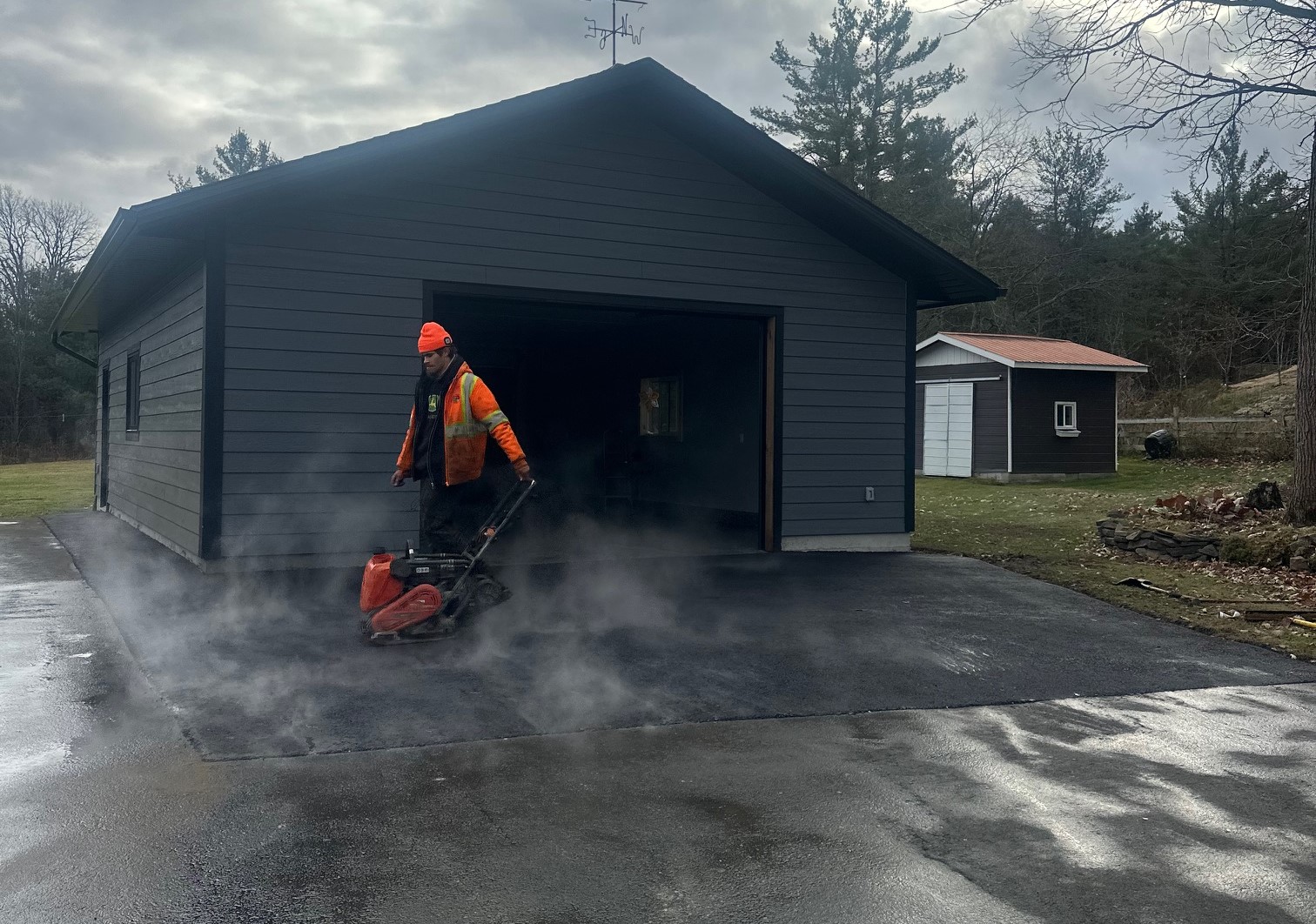
Once fresh asphalt cools below roughly 80°C, it stiffens enough that the stone inside it stops shifting under the roller, and further passes add no density. The time between placement and that point is the compaction window, and in cold conditions it closes quickly.
Heat escapes downward into the ground faster than it escapes into the air, which makes ground temperature a bigger factor than air temperature. Layer thickness works the same way. Published cold-weather figures show the scale of the difference: under late-season conditions a three-inch layer can stay workable for roughly an hour, while an inch-and-a-half layer in the same weather can cool past the threshold in under ten minutes.
Asphalt that never reaches density is porous asphalt. The provincial acceptance range for most mixes is 92 to 96.5 per cent of the maximum density the mix can reach, and an inspector rejects anything under 92 per cent outright. Below that level water works into the surface, freezes, and breaks the pavement apart from the inside.
None of it shows in the first season, and the damage surfaces two or three years later as cracking and surface breakdown.
Daylight Limits The Working Day
OPSS 310 also requires crews to finish spreading and compacting by half an hour after sunset, since fresh asphalt cools quickly once the sun is off the work. Barrie has about nine and a half hours of daylight in November, so once you allow time in the morning for the ground to warm and subtract the evening cutoff, a crew working in late October may have five or six productive hours on site.
Frost dates narrow things further. Barrie’s average last spring frost falls around May 6 and its average first fall frost around October 8, leaving a frost-free period of roughly 153 days. November averages a high of 6°C and a low of 0°C, well below the 7°C minimum for the surface layer.
Asphalt Plant Availability
Temperature rules only matter when there’s asphalt available to buy. Plants shut down over the winter because heating storage tanks, keeping aggregate stockpiles dry, and drying material in cold weather all burn significant fuel, and winter demand doesn’t cover the cost. They reopen in spring as temperatures rise and contract work resumes.
Until then the only material available is cold patch, which is useful for filling a pothole in February and unsuitable for anything meant to last, since it doesn’t bond to the surrounding pavement and works loose under traffic.
Haul distance is a related concern in cottage country. Asphalt loses heat in the truck box, so a longer run from the plant leaves a shorter compaction window when the load arrives. A job in Bala or Baysville works on a tighter margin than the same job in Midhurst on the same day.
Muskoka Runs A Shorter Season Than Simcoe County
The ground in Muskoka freezes deeper and thaws later than in Simcoe County, and fall temperatures arrive earlier. Site conditions add further limits, including private roads that won’t carry a loaded truck, granite close to the surface, seasonal access, and owners who aren’t on the property to review the work.
The best weeks go early, so book a Muskoka driveway for next year over the winter rather than waiting until the following June.
Planning A Project Around The Season
A few things are worth doing before you sign a contract:
- Book early for a mid-season date. June through September is the most reliable stretch and it fills first, so calling in July usually lands you an October slot.
- On larger jobs, ask whether the crew can do the base work separately from the paving. Excavation and gravel placement aren’t subject to the same temperature limits as asphalt, so splitting the work across the season is sometimes the better approach.
- Ask about layer thickness, mix type, and haul distance before agreeing to a late-October date. A late job isn’t automatically poor work, but a contractor who can answer those questions specifically has accounted for the conditions.
- Treat a sudden late-fall opening with some caution. Cancellations are real, and so is end-of-season scheduling of work that should wait until spring.
Don’t Seal A New Driveway The Same Year
New asphalt needs time to cure while the lighter oils in it work out of the surface, and common industry guidance puts that period between six months and a year, longer in a cool climate than a hot one.
Sealing before the surface has cured caps it and traps those oils underneath, which keeps the asphalt soft and leaves it easier to scuff and damage. Decline any offer to seal a driveway within weeks of installation.
Summary
Frost, plant schedules, and temperature set the boundaries of the paving season, and none of them move to suit a schedule.
Most driveways that fail early didn’t fail on poor materials. Crews laid good materials in conditions that didn’t allow proper compaction, on cold ground, late in a season that had already closed. The work looks acceptable on the day it’s finished.
Ital Paving has paved driveways from Barrie north through Muskoka since 1985.
If a driveway is on your list for the coming year, contact us to get on the schedule while good dates remain. Estimates are free, all work carries a written warranty, and we don’t require a deposit. You can request a free paving estimate in Barrie or Muskoka on our contact page.
Related Articles
Residential & Commercial Estimate Request
Ital Paving provides free, no-obligation onsite consultations for all residential and commercial paving projects.
Our experts will perform a technical assessment of your property in Barrie, Orillia, or Muskoka to ensure your new infrastructure meets the highest standards of safety and durability. Complete this short form today to get started.